Every September, China's silk supply chain holds its breath. The autumn cocoon harvest is underway across the main producing regions – and the prices set in these few weeks will ripple through raw silk costs, grey fabric quotes, and finished garment prices for months to come.
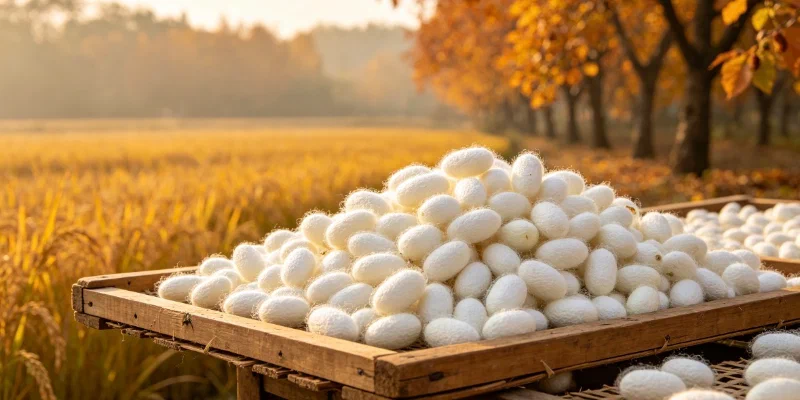
For buyers planning Q4 deliveries or early 2027 orders, understanding what happens during the autumn season isn't optional – it's the difference between a competitive quote and an expensive surprise. Here's what to watch, and what it means for your sourcing decisions.
Why Autumn Cocoon Season Matters
China produces the overwhelming majority of the world's mulberry silk. Within that, the annual harvest is split across several seasons: spring, summer, and autumn. Spring cocoons are traditionally prized for quality, but autumn cocoons are critical for volume.
Guangxi – China's largest cocoon-producing region – leads autumn output, thanks to its warm climate that allows multiple rearing cycles per year. Sichuan, Yunnan, and parts of Zhejiang and Jiangsu also contribute significantly. When autumn cocoons come to market, filatures (raw silk reeling plants) restock, and the price signals set here flow downstream for the rest of the year.
The practical implication for buyers: if you're placing orders now for late 2026 or early 2027 delivery, your quotes are being shaped by what happens in Guangxi and Sichuan this month.
The Three Factors Driving 2026 Autumn Prices
1. Weather and Yield
Late-summer weather in the main producing regions has a direct effect on cocoon yield and quality. Temperature swings, humidity, and the health of mulberry leaf crops all influence how many cocoons reach reeling grade.
In seasons with favourable conditions, autumn output can ease supply pressure and moderate prices. In difficult seasons, yields drop and prices firm up quickly – often within days of the first major auctions.
2. Raw Silk Inventory and Demand
Before the autumn harvest arrives, filatures and weaving mills carry whatever inventory they accumulated earlier in the year. The H1 2026 market saw raw silk prices come under pressure – a signal that demand was not keeping pace with supply in the first half.
That changed the calculus for autumn buying. If mills enter the season with comfortable stock, they can afford to be selective, which tends to cap price upside. If inventory is thin and downstream orders recover, competition for autumn cocoons intensifies.
3. Export Market Sentiment
China's silk exports respond to conditions far beyond its borders. European luxury demand, US import patterns, and the ongoing shift of some volume to alternative origins like Vietnam all feed into how Chinese mills plan their purchases.
When export orders are strong, mills buy aggressively during the autumn window to secure raw material for Q4 and Q1 production. When export sentiment is cautious, they buy hand-to-mouth, and prices can soften.
Cocoon prices don't move fabric prices overnight. There's a lag of two to six weeks as cocoons are reeled into raw silk, raw silk is sold to weaving mills, and grey fabric is produced. Buyers watching the market can anticipate quote changes before they arrive.
Quality: Why Autumn Isn't Spring
Buyers often assume all cocoon seasons are interchangeable. They aren't. Autumn cocoons differ from spring cocoons in ways that matter for downstream fabric.
The key indicators of cocoon quality are:
- Cocoon shell ratio – the proportion of the cocoon that can actually be reeled into silk. Higher is better and more economical.
- Reelability – how cleanly the filament unwinds without breaking. Poor reelability creates more waste and lower-grade silk.
- Filament length – longer continuous filaments produce stronger, smoother yarn.
- Uniformity – consistent cocoon size and shape translates to more even raw silk.
In many years, autumn cocoons reel reasonably well but show less consistency than premium spring cocoons. Late-summer heat stress can affect filament strength, and quality can vary more between batches. This doesn't mean autumn silk is inferior – but it does mean buyers should pay closer attention to batch-level test reports during this period.
What to Watch in the Coming Weeks
If you want to track the autumn season's impact on your sourcing, these are the signals that matter:
| Indicator | Why It Matters | What Buyers Should Do |
|---|---|---|
| Cocoon purchase prices | Sets the cost baseline for raw silk within weeks | Track regional auction results in Guangxi and Sichuan |
| Raw silk (filature) quotes | Directly determines grey fabric cost | Request updated quotes from your mill every 2–3 weeks |
| Cocoon shell ratio & reelability | Affects yield and finished fabric quality | Ask for batch test data on your specific order |
| Mill inventory levels | Determines how aggressively mills buy and price | Ask your supplier directly about stock and lead times |
| Export order sentiment | Drives demand-side pressure on prices | Watch European and US order patterns in your category |
Lock In or Wait? A Practical Framework
This is the question every buyer faces during cocoon season. There's no universal answer, but there is a framework.
Lock in now if:
- You need production completed before Chinese New Year (February 2027)
- Your product uses standard specifications where price is the main variable
- You want certainty and can accept that prices might soften slightly later
Wait if:
- Your orders are for Q2 2027 or later
- You have flexibility on timing and can move quickly when signals are clear
- Your volumes are large enough that even a small price movement matters
Many experienced buyers split the difference: lock a portion of their volume now to secure production slots, and hold the rest for negotiation once the autumn picture is clearer. This hedges both ways without overcommitting.
What This Means for Your Q4 Planning
The autumn cocoon season is not an abstract market event – it's the moment when the cost of your next order is effectively decided. Buyers who understand the rhythm of the season can plan around it; those who don't end up reacting to quotes they didn't see coming.
My advice for the coming weeks: stay in close contact with your supplier, ask specific questions about cocoon sourcing and raw silk inventory, and don't assume last quarter's price still holds. In a season like this, information is leverage.
If you're planning Q4 or Q1 orders and want a ground-level read on what's happening in the producing regions, reach out. I'm in Nanchong, close to the mills, and I see the season unfold in real time.
Frequently Asked Questions
I find. I check. I seal. You relax.