You've bought silk shirts, worn silk pyjamas, and touched silk scarves. But have you ever wondered how the soft fabric in your hands actually travelled from a mulberry leaf to your wardrobe?
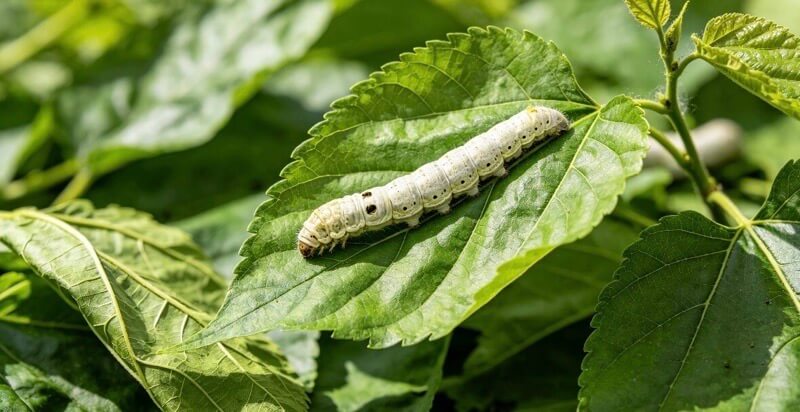
This article takes you through the full journey – from mulberry cultivation and silkworm rearing, to weaving, dyeing, finishing, and finally trade and sales – breaking down every step of the process.
Sericulture: Everything Starts with a Leaf
The origin of silk is not a factory – it is a farm.
Silkworms do not eat just any leaf – they eat mulberry leaves. Mulberry cultivation is the very first link in the silk industry chain. The quality of mulberry leaves directly affects the health of the silkworms, and the health of the silkworms directly determines the quality of the cocoon silk. A mulberry tree takes 2–3 years to mature, and then can be harvested 3–5 times a year.
A silkworm takes about 28 days from hatching to spinning a cocoon. During this period, a single silkworm consumes about 25 grams of mulberry leaves, but produces only 0.5–1 gram of silk fibre. After the silkworm spins its cocoon, the cocoons are collected – this is the raw material for silk.
Reeling: From Cocoon to Raw Silk
Once collected, the cocoons cannot be woven directly. The silk filament is coated with a natural protein called sericin, which glues two filaments together. Part of this sericin must be removed before the silk can be reeled.
Reeling is the process of drawing the continuous filament from the cocoon. A single cocoon can yield approximately 800–1,200 metres of continuous filament. Several filaments are combined to form a single strand of raw silk.
The reeling process includes the following steps: cocoon stripping (removing the loose outer layer), cocoon sorting (selecting uniform cocoons), cooking (softening the sericin in hot water), finding the filament end, and reeling (drawing and winding the silk).
In a modern reeling workshop, dozens of workstations operate in orderly rows, with technicians precisely controlling water temperature and reeling speed. Every detail affects the final quality of the raw silk.
The reeled silk is then subjected to rewinding, dressing, and baling before it can proceed. The quality of raw silk is graded from low to high as B, A, 2A, 3A, 4A, 5A, and 6A. 6A is the highest grade and the grade most commonly used by luxury brands.
6A grade raw silk is the highest commercial quality – it commands a significant premium because of its uniformity, purity, and strength. Only a small fraction of global production reaches this level.
Weaving: From Raw Silk to Grey Fabric
Raw silk arrives at the weaving mill, where it must undergo several preparatory steps before being woven.
These preparations include: impregnation (softening the sericin), doubling and twisting (combining or twisting multiple threads to improve properties), warping (arranging the warp yarns), and picking (preparing the weft).
There are two main weaving approaches:
- Grey weaving (raw weaving): The warp and weft are woven without prior dyeing, producing a white or off-white fabric known as grey silk. This fabric is then sent for dyeing and finishing. This method is cost-effective and faster, and is currently the dominant production model.
- Yarn-dyed weaving: The yarns are dyed before weaving, producing fabric that is already coloured and does not require further dyeing. This is typically used for high-end fabrics such as brocade and taffeta.
Modern weaving relies primarily on rapier looms and water-jet looms. Rapier looms are suited for multi-colour weft and jacquard weaving, while water-jet looms are preferred for filament yarns.
In a weaving workshop, rows of looms are arranged neatly, and under the lights, threads interlace to form fabric. Workers move between the looms, adjusting parameters and checking for defects to ensure every piece is even and consistent.
The fabric produced at this stage is called grey fabric. It is still a semi-finished product – stiff, dull in appearance, and uniform in colour.
Finishing: From Grey Fabric to Finished Fabric
To become the soft, lustrous, coloured silk fabric you recognise, grey fabric must undergo a series of finishing processes. The finishing stage typically includes four core steps:
1. Degumming. Raw silk consists of fibroin and sericin. The sericin coats the filaments, making the fabric stiff and dull. Degumming uses a soap-and-alkali solution in hot water to remove the sericin and other impurities. After this step, the fabric begins to soften and develop its characteristic sheen.
2. Dyeing. Silk is a protein fibre and is sensitive to alkalis, so dyeing must be carried out in acidic or neutral conditions. Common dyes include reactive dyes and acid dyes.
3. Printing. If patterns are required, the fabric undergoes printing. The key difference from dyeing is that dyeing colours the entire fabric, while printing applies colour to specific areas. Modern printing technology has advanced to digital inkjet printing, with patterns controlled by computer.
4. Finishing. This is the final step. It addresses issues left from earlier processes – such as inadequate softness, uneven width, or excessive wrinkling – through mechanical and chemical treatments, to achieve the desired softness, smoothness, and wrinkle resistance.
Trade and Sales: From Factory to Consumer
Once the fabric is finished, it enters the trade and sales stage.
The silk industry chain is long, covering mulberry cultivation, cocoon harvesting and drying, reeling, silk floss production, dyeing and printing, and market sales. From a single thread to a finished garment, the product may pass through multiple hands.
The traditional silk trade route is: mill → trader → brand → retail → consumer. Each layer adds cost and margin.
A recent trend is cross-border e-commerce. Silk products are sold directly to overseas consumers through online platforms, reducing intermediaries. Some domestic silk-producing regions are also building online channels, using live streaming and e-commerce to reach consumers directly.
From Leaf to Wardrobe: Every Step Removes Something
The journey of a silk fabric is, in essence, a process of subtraction:
- Mulberry cultivation turns sunlight and water into leaves.
- The silkworm transforms plant protein into animal protein.
- Reeling extracts a continuous filament from the cocoon.
- Weaving interlaces threads into cloth.
- Finishing removes unwanted components – sericin, impurities – leaving softness, luster, and colour.
At each step, something is removed. At each step, the fabric moves closer to the garment you want to wear.
The next time you touch a piece of silk, think about the path it has travelled – from the leaves of a mulberry tree, to the silk within a silkworm, to the long filament on a reeling machine, to the loom, to the dye vat, and finally to your hands.
Three thousand years have passed, and this path has not changed.
Frequently Asked Questions
I find. I check. I seal. You relax.