If you follow China's silk industry, you probably know the trend: sericulture is moving west. But you might not know that the biggest winner of this two-decade industrial shift is Guangxi.
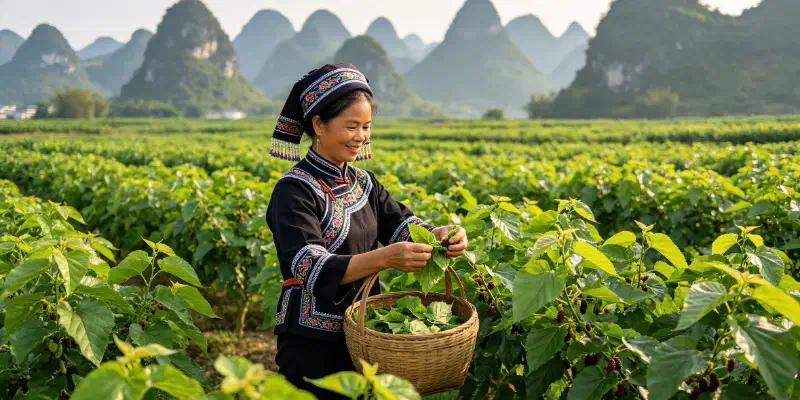
In 2026, Guangxi's cocoon output has ranked first in China for many years running. In Yizhou, Hechi, locals say: "The world's sericulture looks to China; China's looks to Guangxi; Guangxi's looks to Yizhou."
This is not a slogan. It's a fact.
From Supporting Role to Leading Role: Guangxi's Rise
Before 2005, Guangxi was a minor player in China's sericulture, ranking fifth in cocoon output – far behind traditional powerhouses like Jiangsu, Zhejiang, and Sichuan.
In 2006, the Ministry of Commerce launched the "East Mulberry West Transfer" policy, aiming to shift mulberry cultivation and silkworm rearing from the resource-scarce, high-cost eastern coastal provinces to the central and western regions. The east had rising land and labour costs and shrinking mulberry acreage; Guangxi had a subtropical climate, spare land, and surplus labour – the conditions were already there.
Guangxi seized the opportunity.
By 2010, Guangxi's cocoon output had overtaken all other provinces to become the national leader – a position it has never relinquished. In 2026, the region has formed multiple core production areas including Yizhou, Huanjiang, Xiangzhou, and Xincheng, with Yizhou being the acknowledged "hometown of Chinese sericulture", producing over a quarter of Guangxi's total cocoons.
What Guangxi Did Right
Guangxi's success is not simply a matter of "the east moves out, the west takes over". The region made several smart moves during the transition.
Move 1: From 3–4 batches per year to 8–10.
Traditional eastern silkworm areas rear 3–4 batches annually. Guangxi's subtropical climate allows for 8–10 batches per year – more than double the output from the same mulberry acreage.
Move 2: Collective rearing of young silkworms – solving the survival problem for smallholders.
Silkworms in their first three instars are prone to disease and have high mortality rates. Guangxi promoted the "collective rearing" model: villages or cooperatives build centralised facilities to rear silkworms up to the third instar, then distribute them to individual farmers. This system achieves survival rates above 95%, far higher than the 70–80% typical of scattered household rearing.
Move 3: Artificial feed and factory-based sericulture.
Traditional rearing relies on fresh mulberry leaves, which are seasonal and weather-dependent. Guangxi was an early adopter of artificial feed – a formulated diet made from mulberry leaf powder, soybean meal, and other nutrients – which eliminates reliance on fresh leaves and enables year-round, factory-style production. Farmers can now rear 10+ batches per year, further boosting capacity and efficiency.
In Yizhou, some large-scale sericulture bases have already achieved "rearing without reliance on weather, production without interruption all year round" – exactly the goal of the "East Mulberry West Transfer" policy: shifting from "labour-intensive agriculture" to "smart agriculture".
Guangxi's success shows that policy plus climate, plus the right technology, can transform a region's position in the global silk supply chain. For buyers, this means a new, cost-competitive source of raw silk is now well-established.
From Raw Material to Finished Product: Extending the Value Chain
Output increased – but then came the next problem. Guangxi's cocoon quality was variable, with most capable only of producing mid-to-low-grade raw silk, mostly sold to weaving mills in Zhejiang and Jiangsu as raw material. This is the classic "raw-material production zone" dilemma: high volume, low added value.
In recent years, Guangxi has begun to address this. Yizhou has introduced advanced reeling equipment, promoted 6A-grade raw silk production technology, and some local enterprises now produce silk that meets 6A standards, directly supplying European luxury brands. At the same time, Guangxi is extending its downstream chain – weaving, dyeing, garment manufacturing, and silk cultural products are gradually taking root.
Guangxi's "comeback" is not just about quantity – it's about quality too.
What This Means for Buyers
If you are sourcing silk, the rise of Guangxi offers several implications:
- A new, cost-competitive source. Guangxi raw silk is often 5–10% cheaper than that from the Jiangsu-Zhejiang region, and the quality gap is narrowing. For price-sensitive mid-tier brands, Guangxi is worth investigating.
- Pay attention to grade. While 6A-grade Guangxi silk has entered European luxury supply chains, the majority of production still sits at 3A–4A. Always specify your grade requirement and request test reports.
- Shorter supply chains. In the past, Guangxi's raw silk had to be shipped to Zhejiang for weaving and then to Guangdong for export. Now, some weaving and dyeing capacity is moving directly to Guangxi, shortening the distance from raw material to finished product.
- Ongoing policy support. After the "East Mulberry West Transfer" policy, the government is now promoting the "East Silk West Consolidation" strategy, moving high-end weaving, dyeing, and brand resources to the interior – and Guangxi is a key recipient region.
Guangxi's story is one of a region that "took on the transfer and exceeded expectations". It reminds us that industrial transfer is never a simple "move" – it's about new growth in a new environment.
Frequently Asked Questions
I find. I check. I seal. You relax.