You've found a silk supplier in China. The price is right, the momme weight looks good, and they promise "high quality." But when the rolls arrive at your studio or warehouse — will they match what you expected?
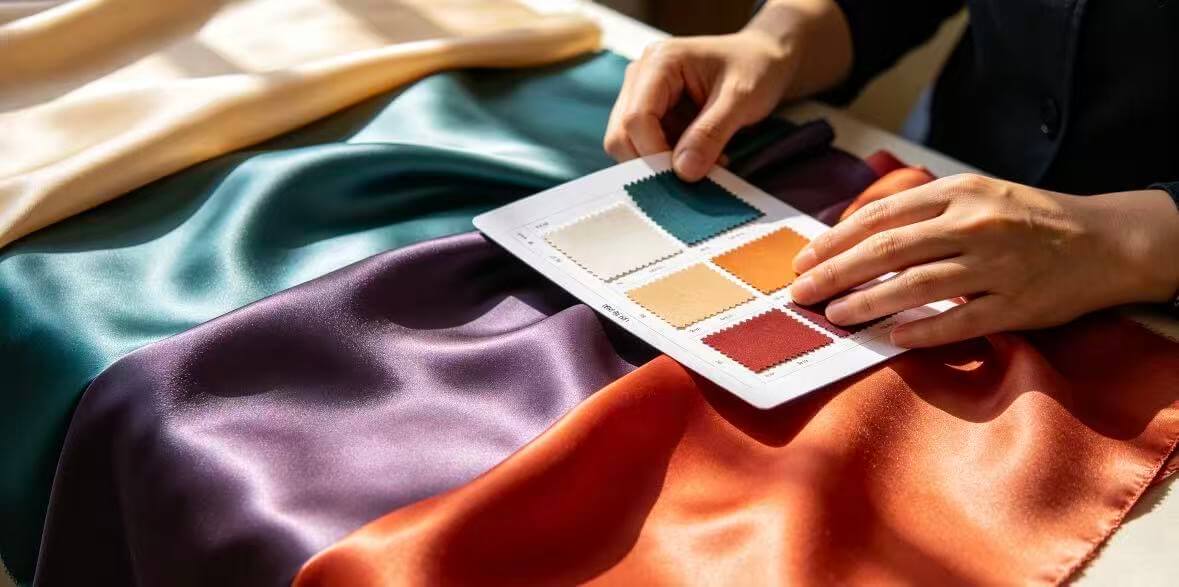
Color variation. Weave defects. Hidden stains. Different hand feel. These are the most common complaints from small fashion brands and independent designers who import silk without a proper inspection.
The good news: you don't need to fly to China. You can either hire a local inspection partner (like us at Silk.Sale) or follow this 5-step pre-shipment checklist to train your own eye. Let's make sure the silk you pay for is the silk you get.
Step 1 — Verify Momme Weight, Width & Composition
Before you even look at the fabric under light, check the physical specifications against your purchase order.
- Momme weight (mm) — Use a silk momme meter or precision scale. For example, 19mm satin should feel noticeably lighter than 30mm. A 5% variance is acceptable; more than that, reject.
- Fabric width — Measure roll width (usually 44″, 54″, or 55″ for silks). Narrower than agreed means less yield for your patterns.
- Composition — Real mulberry silk burns with a protein smell (like burnt hair) and leaves a crisp, crushable ash. Polyester melts and smells like plastic. Keep a small sample from your first order as a reference.
Pro tip: Ask your supplier for a lab test certificate (OEKO-TEX, SGS, or ISO) if you need formal composition proof. For a quick on-site check, the burn test works.
Step 2 — Run the Light Table Test for Weaving Defects
Silk fabric is woven — and weaving defects are common, especially with lower-grade silk (3A, 4A vs 6A). Place the fabric on a light table or hold it against a bright window. Look for:
- Slubs — Thick, uneven spots in the yarn. Small slubs are acceptable in raw silk (like habotai); in satin or charmeuse, they should be nearly invisible.
- Broken ends or picks — Missing threads create holes or thin lines.
- Reed marks — Visible lines running parallel to the selvage from uneven warp spacing.
- Stains or oil spots — Often from machine maintenance. Any stain larger than 1 cm² is a rejection.
Acceptance standard for most brands: No more than 2 minor defects per 10 linear meters. Major defects (holes, broken ends >2 cm) — zero tolerance.
Step 3 — Check Color Consistency (Roll-to-Roll and Within Roll)
Color variation is the #1 complaint from buyers, especially for dyed silk.
- Compare the start and end of the same roll — unroll 3–5 meters, then another 3–5 meters from the core. Are they identical?
- Compare multiple rolls of the same color code — lay pieces side by side under natural daylight (or a D65 standard light box). Human eyes are good at catching differences.
- Use a colorimeter (optional) — A handheld device like a Nix Mini gives numerical ΔE values. ΔE < 1.5 is excellent; ΔE > 3.0 is noticeable and a likely reject.
At Silk.Sale, we attach a unique anti-counterfeit label to every inspected roll and include a video report showing the color check under natural light — so you don't have to guess.
Step 4 — Feel & Drape Test (Hand Feel)
Silk is loved for its hand feel — soft, smooth, with a natural luster. Machine issues or wrong finishing can ruin it. Always compare your inspection sample against the original approved sample your supplier sent during sampling.
- Touch: Does it feel equally soft? Gritty or scratchy means poor quality yarn or harsh chemical finishing.
- Drape: Hold a 50×50 cm piece over your hand. Good silk satin flows like water. Stiff silk has too much sizing (which washes out, but you're paying for correct finishing).
- Luster: Real mulberry silk has a subtle, deep shine — not a plastic glare. If it looks like polyester, it might be fake or low-grade.
Trust your fingers. If it doesn't feel right, it probably isn't.
Step 5 — Shrinkage & Colorfastness Spot Test
You don't need to wash the whole roll — a small sample is enough. Cut a 50×50 cm piece from the roll and:
- Measure and mark its exact dimensions.
- Wash it as your production will (gentle cycle, cold water, mild detergent).
- Dry and re-measure. Acceptable shrinkage: ≤3% in length and width. More than that will ruin your patterns.
Colorfastness: Check the wash water — if it turns noticeably colored, the dye is poorly fixed. Also rub a dry white cloth firmly on the fabric; any color transfer means it will stain other garments.
Bonus: What If You Can't Inspect in Person?
You have three options:
- Ask the supplier for a pre-shipment video — but they control the camera. Not fully reliable.
- Hire a third-party inspection company (SGS or Bureau Veritas) — professional, but expensive (often $300–600 per day plus travel).
- Work with a personal sourcing & inspection partner — someone like us at Silk.Sale, based in Nanchong (China's Silk Capital). We visit your supplier's warehouse, inspect every roll using this checklist, apply a tamper-proof label, and send you a video report. You only pay a small commission when you buy.
Final Checklist Summary
| Step | What to Check | Pass / Fail |
|---|---|---|
| 1 | Momme weight, width, composition | ☐ |
| 2 | Weaving defects (light table) | ☐ |
| 3 | Color consistency (roll to roll) | ☐ |
| 4 | Hand feel and drape | ☐ |
| 5 | Shrinkage & colorfastness (spot test) | ☐ |
I find. I check. You relax.