You've found a supplier offering "100% pure mulberry silk" at an attractive price. The swatch looks beautiful. But when the bulk order arrives, something feels off — the texture is different, the colour isn't quite right, and you start to wonder: is this really silk? This scenario plays out more often than you'd think. Counterfeit and adulterated silk products have become increasingly sophisticated, and even experienced buyers can be deceived.
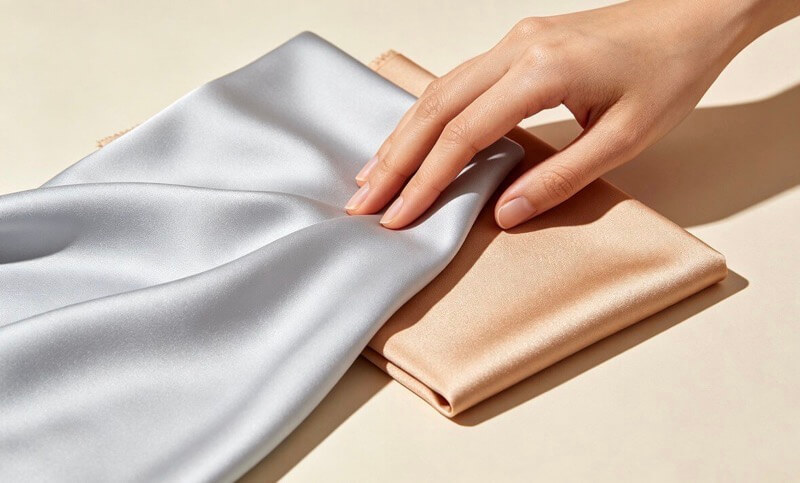
Whether you're a fashion designer, brand owner, or production manager, knowing how to identify genuine silk is an essential skill. In this guide, I'll share five practical tests you can perform to distinguish real silk from imitations — methods used by industry professionals that require minimal equipment.
Test 1: The Burn Test (Most Reliable)
The burn test is the most definitive way to identify real silk because it reveals the fundamental nature of the fibre: protein-based (silk) vs. cellulose-based (cotton, rayon) or synthetic (polyester, nylon).
How to do it:
- Take a small thread or a few yarns pulled from the fabric's selvage or a hidden area.
- Hold the yarn with tweezers and place it near a flame — not directly in it, but close enough to ignite.
- Observe how it burns, the smell, and the ash residue.
Silk burns slowly, curls away from the flame, and produces a smell similar to burnt hair (due to its protein content). The ash is black, crisp, and easily crumbles into a fine powder.
What to watch out for:
- Cotton or rayon: Burns quickly with a yellow flame, smells like burning paper, leaves a grey, feathery ash.
- Polyester or nylon: Melts and shrinks away from the flame, smells like burning plastic, leaves a hard, bead-like residue.
- Silk blends: Mixed results — a silk-polyester blend will show both the protein burn smell and some plastic bead formation.
Test 2: The Luster Test
Real silk has a unique, deep, multifaceted luster that synthetic fibres cannot replicate. It's not a harsh, plastic shine, but a soft glow that shifts subtly as you move the fabric under light.
How to do it:
- Hold the fabric under a single light source (like a desk lamp) and observe the reflection from different angles.
- Real silk reflects light softly, with a subtle shimmer that changes with the angle. The surface appears to have depth.
- Polyester or acetate often reflects light sharply and uniformly, creating a "glare" that doesn't change much with the angle.
Silk's luster comes from its triangular prism-like cross-section, which refracts light. This is a natural characteristic that no synthetic has been able to fully copy — though some high-quality microfibres come close.
Test 3: The Touch (Hand Feel) Test
Silk is famous for its exceptional hand feel — smooth, soft, and with a natural, slightly "cool" sensation when it first touches the skin. It's neither slippery nor waxy.
How to do it:
- Close your eyes and focus purely on the tactile sensation. Rub the fabric between your thumb and forefinger.
- Real silk feels uniquely smooth, with a light, airy weight. It warms quickly against the skin.
- Fake silk (especially polyester satin) often feels slippery or sticky, lacks the natural softness, and can feel "plasticky" or overly slick.
Test 4: The Wrinkle Test
Silk has a natural elasticity that allows it to resist creasing, though it's not as wrinkle-free as some synthetics. The way it wrinkles and recovers is telling.
How to do it:
- Take a piece of fabric and crumple it tightly in your hand for a few seconds, then release it and observe.
- Real silk will show some wrinkles, but they will be fine and soft, not sharp or harsh. When you smooth it with your hand, the wrinkles will relax and partially disappear.
- Polyester tends to be wrinkle-resistant and recovers without the same soft drape. Low-quality viscose or rayon may hold deep, sharp creases.
Test 5: The Price Check
This isn't a laboratory test, but it's a highly effective filter. Genuine 6A mulberry silk, produced from premium cocoons in regions like Nanchong, comes with a significant cost. If the price seems "too good to be true", it almost certainly is.
Key cost factors:
- Raw material: High-grade silk is expensive due to the labour-intensive cultivation and reeling process.
- Weaving and finishing: Quality mills invest in skilled labour and equipment to ensure consistency.
- Inspection and compliance: OEKO-TEX, colourfastness, and SGS testing all add to the cost.
For 6A grade 19–25mm charmeuse, a realistic FOB price from Nanchong in 2026 is approximately $19–20 per metre for 19mm charmeuse, and $35–37 per metre for 25mm charmeuse. Prices significantly below these ranges are a red flag — the fabric is likely a lower grade, a blend, or a synthetic substitute.
Why Professional Verification Matters
While these five tests are valuable tools for initial screening, they have limitations — especially when dealing with high-quality fakes or blends. For serious B2B sourcing, you need more than a home-based test.
At Silk.Sale, we go beyond surface checks:
- We source directly from certified 6A mulberry silk mills in Nanchong, where the supply chain is transparent.
- Every order undergoes a multi-stage inspection — including composition, weight, colour consistency, and defect checks under professional lighting.
- We provide a video report of the inspection, so you see exactly what we see before shipment.
- Each inspected roll is sealed with a tamper-proof anti-fake label, ensuring traceability and authenticity.
"I used to rely on the burn test and luster check for every sample. But when I started working with Silk.Sale, I realised how much I was missing — they caught defects and inconsistencies I never would have spotted. It's given me total peace of mind." — A European brand owner
Conclusion: Trust, But Verify
Knowing how to identify genuine silk is an essential skill for any buyer. The burn test, luster observation, touch, wrinkle behaviour, and price awareness give you a solid foundation to filter out obvious imitations.
For reliable, scalable sourcing — especially for small to mid-sized brands — you need a partner who is on the ground, inspecting every roll before it ships. That's the Silk.Sale difference.
Frequently Asked Questions
I find. I check. I seal. You relax.