Italy has long been the global heart of luxury fashion and fine silk. Its trade flows reveal where the world's most discerning buyers are sourcing their silk — and what that means for small brands like yours.
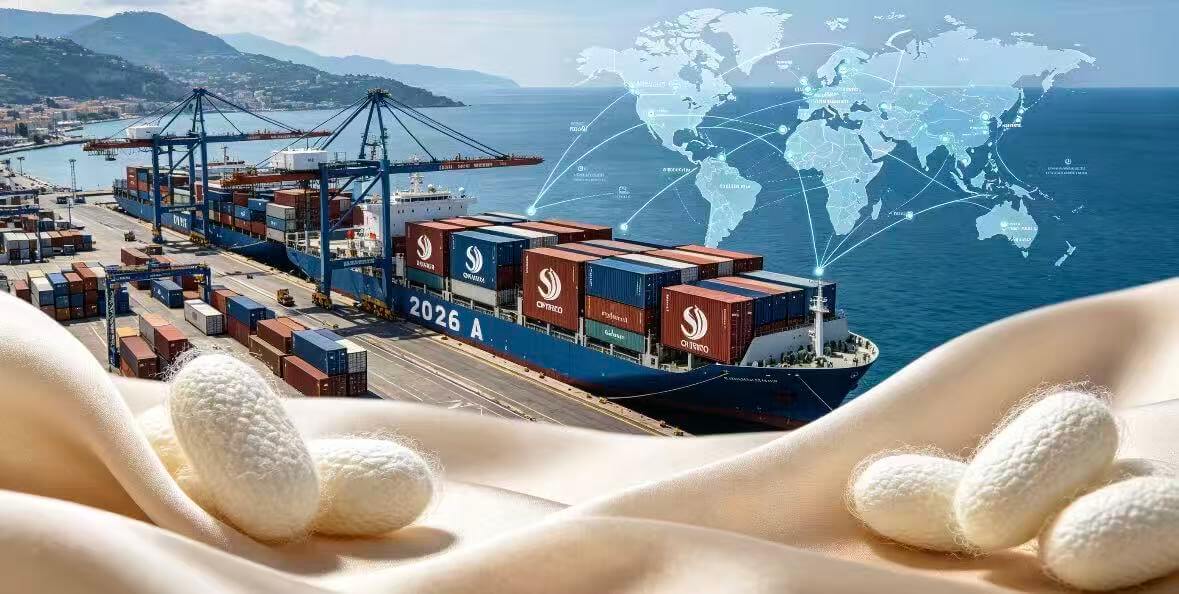
According to the latest data from the China Chamber of Commerce for Import and Export of Textiles and Apparel, compiled from Eurostat statistics, Italy's silk trade in the first four months of 2026 tells a compelling story. Let's break it down.
Overview: Stable Trade, Shifting Flows
From January to April 2026, Italy's total foreign trade in silk goods reached $1.946 billion — a slight 0.70% decrease compared to the same period in 2025.
- Exports grew by 1.42% to $1.301 billion.
- Imports declined by 4.72% to $645 million.
In short: Italy is exporting more high-value silk goods while importing slightly less. But where is the silk going — and where is it coming from?
Where Is Italy Exporting Its Silk?
| Country / Region | Export Value (USD) | Share | Change |
|---|---|---|---|
| France | $169.1M | 13.0% | −3.37% |
| United States | $146.6M | 11.3% | +11.92% |
| Germany | $78.7M | 6.0% | −11.67% |
| China | $58.0M | 4.5% | +17.66% |
| Spain | $55.7M | 4.3% | −4.90% |
The United States remains a growth engine for Italian silk exports, while China — the world's largest silk producer — is importing more Italian silk goods, up 17.66%. This reflects the growing demand for high-end Italian design and craftsmanship in the Chinese market.
Exports to the US surged 11.92%, confirming that American demand for Italian silk luxury goods remains strong. If you're selling into the US market, you're aligned with a growing trend.
Where Is Italy Sourcing Its Silk From?
| Country / Region | Import Value (USD) | Share | Change |
|---|---|---|---|
| China | $177.2M | 27.5% | +13.84% |
| France | $51.2M | 7.9% | −12.03% |
| Romania | $38.4M | 6.0% | −24.64% |
| Spain | $37.8M | 5.9% | −23.01% |
| Bangladesh | $35.7M | 5.5% | −15.52% |
China remains Italy's single largest supplier of silk goods, and the share is growing. Italy imported over $177 million worth of silk from China in the first four months of 2026 — a 13.84% increase. Meanwhile every other major supplier lost ground.
"Italy imports more silk yarn and fabric from China than from any other country — and those imports are growing. This confirms that 6A mulberry silk from China meets the standards of the world's most demanding luxury market."
What This Means for Small Brands
1. Chinese silk quality is competing at the highest level.
If Italy — the heart of global luxury — is sourcing more of its silk from China, you can access the same quality without the Italian markup. Italian fabric imports from China grew 16.41%, while Turkey and France lost ground.
2. The US and China are the key growth markets.
Italian silk exports are rising fastest to the US (+11.9%) and China (+17.7%). If you're selling into either market — or sourcing inspiration from them — you're aligned with global trends.
3. Direct sourcing from Nanchong makes sense.
If Italy is importing more silk yarn and fabric from China, why wouldn't you? But the key is how you source — with proper quality control, transparent pricing, and a partner you trust.
Italy's Success Is Built on Partnership and Quality
Italian fashion houses don't just buy silk from a website. They work with trusted partners who understand quality, consistency, and craftsmanship. That's exactly the relationship I offer as your silk friend in Nanchong.
When you work with me:
- I source from the same Nanchong mills that produce silk for export to Italy and beyond.
- I personally inspect every roll — weight, color, weave, hand feel — and send you a video report.
- I seal each roll with a tamper-proof anti-fake label.
- I coordinate logistics end-to-end, from mill to your door.
You get Italian-level quality at factory-direct prices, without the Italian markup.
I find. I check. You relax.