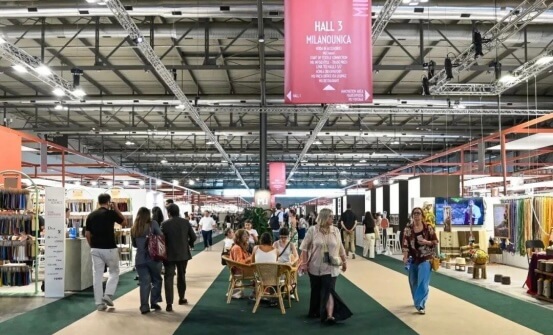
From 7 to 9 July, the 43rd edition of Milano Unica – the premier high-end fabric fair – took place at Fieramilano Rho. The name may not be familiar to everyone, but in the global luxury textile industry, it is the definitive trendsetter.
This year's fair sent three clear signals. For the Chinese silk industry, these are not just "trend suggestions" – they are new barriers to entry.
737 Exhibitors, Growing Global Commercial Influence
The fair hosted 737 companies, of which 460 were Italian – over 60% of the total. The number of European exhibitors increased by 15.2% year-on-year. Nearly half of the professional buyers came from overseas, with significant growth from France, Japan, South Korea, the UK, and the US, while Chinese and German buyers remained stable.
The fair was divided into three core areas: Ideabiella (worsted suiting), Moda In (silk womenswear), and Shirt Avenue (shirting). The Moda In silk section presented the cutting edge of the global luxury silk supply chain.
The China Textile and Apparel Association sent a delegation to Milan for on-site observation, focusing on the AW 2027/28 high-end silk fabric trends, luxury purchasing standards, and global textile sustainability systems. The team visited the silk section, the MU Tendenza trend area, the sustainable materials innovation area, and participated in several forums.
The conclusion was clear: the global high-end silk industry is forming three irreversible core trends.
Trend 1: Green Certifications – From Bonus to Entry Ticket
At the fair, over 90% of high-end silk fabrics already held international eco-certifications such as GOTS, OEKO-TEX, and Bluesign. This was not a differentiating strategy by a few exhibitors – it was the norm across the entire section.
Recycled silk, bio-based composite fibres, and low-temperature, low-water dyeing and finishing processes have all been fully commercialised. Low-carbon traceability, restricted substance lists, and animal-friendly raw material sourcing have become pre-requisites for order placement by leading European luxury brands.
In the past, certifications were a "bonus" – nice to have, but not essential. Now they are an entry ticket. Without GOTS, OEKO-TEX, or Bluesign, Chinese suppliers will not even get a seat at the negotiation table with top-tier international buyers.
Trend 2: "Small Batch, Fast Response" Replaces the Mass-Order Model
European luxury and accessible-luxury brands have fully moved away from large-standard-batch fabric procurement. The new demand is for exclusive art jacquards, hand-finished textures, and limited-edition digital-printed silk. Brands require rapid sampling and flexible small-lot delivery.
Italian exhibitors, relying on fully digital weaving and high-speed digital printing equipment, have already built agile supply chains. They can switch between categories quickly and match the bespoke development needs of brands.
For Chinese suppliers: the industry has long excelled at "large volume, low cost". But the international premium market now demands "small volume, differentiation, and fast response". This is not a passing fad – it is a structural shift. Digital transformation and flexible production upgrades are no longer a "should-we" question, but a "how-fast" one.
Trend 3: The Boundaries of Silk Are Being Redefined
Blends – wool-silk, cashmere-silk, linen-silk, and recycled-silk blends – accounted for over 60% of the silk exhibits. The application scope of silk has expanded beyond traditional scarves and womenswear into high-end lingerie, home soft furnishings, luxury bag linings, and functional outdoor fabrics.
For Chinese suppliers: the industry has long struggled with product homogeneity and price competition. Cross-sector blending offers a clear path to differentiation – silk does not have to be limited to "clothing". It can enter many higher-value segments. The challenge lies in whether domestic mills have the R&D capability and cross-disciplinary thinking to seize these opportunities.
Final Thoughts
From January to May 2026, China's silk goods exports reached USD 561 million, up 3.91% year-on-year. Exports are growing – but the quality and direction of that growth deserve equal attention.
The three trends from Milano Unica – green certifications, agile customisation, and cross-sector blending – all point in the same direction: the international premium market is redefining what "good silk" means. The standard is no longer just "6A grade" or "momme weight", but now encompasses sustainability, responsiveness, and innovation.
For the Chinese silk industry, the good news is that these changes have already happened and the direction is clear. The bad news is that there is little time left for观望 and hesitation.
Frequently Asked Questions
I find. I check. I seal. You relax.