In June 2026, the People's Daily published a story titled "A Thousand Years of Silk, Woven into Youthful Style". The article highlighted a fascinating development: silk doll clothing has gone viral.
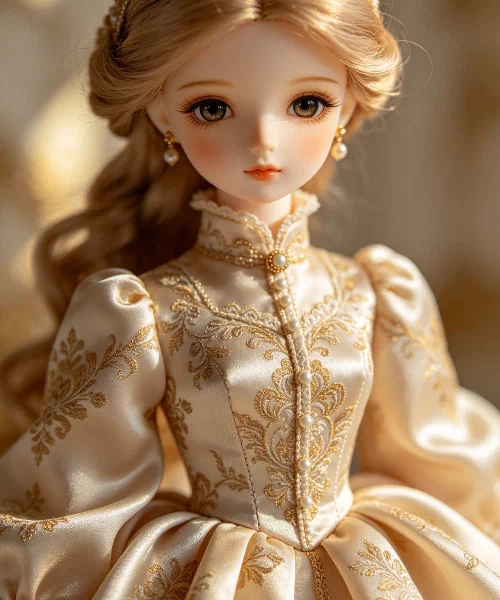
Rows of collectible dolls are now dressed in miniature Chinese-style garments – cloud-collar jackets, pleated horse-face skirts, and Song brocade pinafores. These clothes are made from traditional fabrics like Song brocade, Xiangyunsha, and Luo. One textile company, originally a silk fabric supplier, has seen its monthly sales of Chinese-style silk fabric reach over 30,000 metres, driven entirely by demand for doll clothing.
It sounds like a niche hobby – but the market behind it is far larger than you might imagine.
An Unexpected Hit
The company's founder initially made a few doll outfits on a whim and posted them on social media. The response was overwhelming – orders started pouring in. Within days of the first design being shared, customers were asking for custom work, from pattern to finished piece.
"Let intangible cultural heritage ride the trend wave. Let collectible toys carry deeper cultural meaning."
That spontaneous project turned into a phenomenon. Monthly sales of Chinese-style silk fabric from this single company exceeded 30,000 metres. On e-commerce platforms alone, monthly revenue from doll clothing and accessories surpassed RMB 100 million.
Not an Isolated Phenomenon
The doll clothing market is experiencing explosive growth.
Industry data shows that in 2024, doll clothing sales grew over 117% year-on-year. By 2025, the total domestic market for all doll clothing categories had exceeded RMB 11.7 billion.
The consumer base is predominantly young – aged 18 to 30. They are drawn to designs that incorporate traditional Chinese elements like New Chinese-style silk vests and ethnic costumes. They are willing to pay for personalised, emotionally resonant experiences – some custom doll garments sell for over RMB 2,000.
This is no longer a niche hobby. It is a billion-yuan "emotional consumption" market.
Doll clothing represents a new frontier for silk. It proves that traditional fabrics can find entirely new markets when paired with the right consumer context – in this case, the emotional connection young people have with collectibles and self-expression.
Why Silk Works for Doll Clothing
Why do doll clothing makers choose silk?
First, material properties align. Traditional silk fabrics like Song brocade, Xiangyunsha, and Luo have fine textures and warm luster. On miniature garments, these qualities become even more visible and detailed. A well-made silk doll garment has a quality that synthetic fabrics simply cannot match.
Second, craftsmanship is valued. Take Luo, a traditional Chinese silk weave. In ancient times it was worth its weight in gold. Its weaving technique is exceptionally complex – the warp threads twist continuously like a braid, while the weft threads must remain parallel. A traditional loom could produce only six or seven metres a day; modern technology has increased that to 70 metres a day. The latest "soft smoke Luo" fabric is so fine that a single blouse weighs less than 50 grams and can be folded into a matchbox. These technological breakthroughs have made it possible to scale up production for miniature garments.
Third, it aligns with aesthetic trends. "To young people, Guochao is not 'old-fashioned' – it is the very definition of trendiness," as one industry insider put it. The cultural heritage embedded in silk fabrics resonates perfectly with the current generation's aesthetic preferences.
What This Means for the Silk Industry
While doll clothing is a niche segment, it reveals a broader trend: silk is moving beyond traditional applications into entirely new consumer categories.
For silk fabric suppliers, this points to several opportunities:
- More diverse fabric requirements. Doll clothing, collectibles, and cultural products demand different qualities from traditional apparel – lighter weight, finer texture, and better pattern definition at small scale.
- Small-batch, multi-variety production is becoming the norm. Doll clothing orders are typically small in quantity but high in variety. This calls for flexible supply chains – exactly the direction many Chinese silk mills are moving towards.
- Guochao consumption continues to grow. During the 2026 Spring Festival, accessories and home goods combining traditional crafts like Su embroidery and Shu embroidery with modern aesthetics became "New Year's trend items" for young consumers. Silk, as one of the core fabrics of Guochao, is gaining new momentum.
Beyond Doll Clothing
A piece of silk fabric can be made into a formal gown costing thousands of yuan, or into a doll garment costing a few hundred. The size of the market is not determined by the fabric itself – it is determined by finding the right application.
The doll clothing segment has taken off not because silk has changed, but because consumption has changed. Young people are willing to pay for emotion. They are willing to pay for aesthetics. They are willing to pay for their passions – and silk fabrics happen to be perfectly suited to carrying those values.
For the silk industry, the real question is not "how much doll clothing can we sell" but "what other scenarios haven't we thought of yet?"
Frequently Asked Questions
I find. I check. I seal. You relax.