You've vetted the supplier. You've approved the sample. The container arrives, and you unroll the first bolt — and there it is. A faint warp streak running the full length. A colour patch that doesn't quite match. A small snag near the selvedge. Now what?
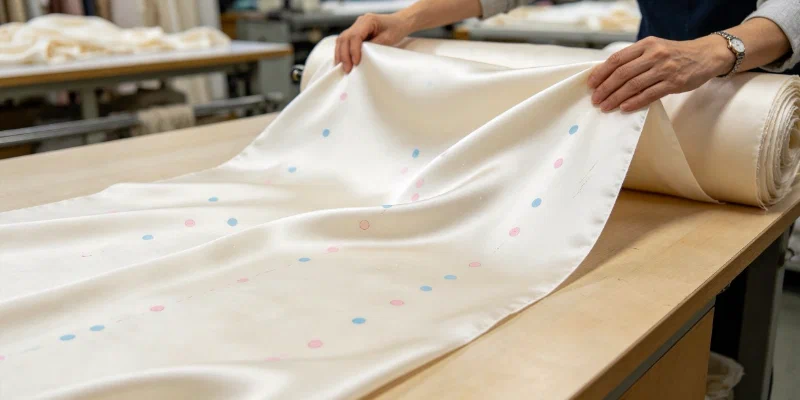
This is where most buyers get stuck. Reject everything and you may lose a good supplier over normal natural-fibre variation. Accept everything and you'll ship flawed garments to your customers. The art lies in knowing where the line falls.
Why Silk Is Different from Cotton or Synthetics
Before you can judge a defect, you need to understand what silk is up against.
Silk is a natural protein filament produced by a living organism. Unlike polyester, which is extruded to perfectly uniform specifications, silk yarn varies in thickness, strength, and colour along its length. Even the finest mulberry silk contains small irregularities — thin places, thick places, occasional slubs — that are inherent to the fibre, not a manufacturing fault.
This matters because zero-defect silk does not exist at commercial scale. The question is never "are there any defects?" It is "are the defects within tolerance for this product, at this price, for this end use?"
A silk scarf sold at €40 and a silk blouse sold at €400 have different tolerances. Your acceptance criteria should reflect that.
The Three Stages Where Defects Originate
Knowing where a defect comes from helps you judge whether it's a one-off or a systemic problem. Silk defects generally originate at one of three stages.
1. Reeling and Raw Silk
Problems at the filature stage show up as yarn-level irregularities:
- Thin or thick places — variations in filament diameter along the yarn
- Slubs — small lumps of tangled fibre, sometimes natural, sometimes from poor reeling
- Uneven twist — inconsistent twist that affects the yarn's appearance and strength
- Contamination — foreign fibres or debris reeled in with the silk
These defects are often subtle and may only become visible after dyeing, when they absorb colour differently.
2. Weaving
Weaving defects are usually the most visible and the most common cause of disputes:
- Warp streaks (经柳) — lengthwise lines caused by uneven warp tension, differing yarn lots, or a faulty heald. Visible as subtle stripes running the full length of the piece.
- Weft bars (纬档) — crosswise bands where the weft density or yarn differs. Often caused by a loom stop, a bobbin change, or inconsistent weft yarn.
- Missing warp or weft ends — a thread absent from the weave, leaving a visible gap.
- Reed marks — fine lengthwise lines from the reed, sometimes acceptable if faint.
- Snags or pulls — a thread pulled out of the weave, creating a visible loop or distortion.
- Selvedge defects — frayed, wavy, or slack edges, which affect cutting yield.
3. Dyeing and Finishing
Dyeing defects can be the most damaging because they often affect the entire piece:
- Colour shading — variation in shade across a piece, between pieces in the same lot, or between lots
- Dye spots or stains — patches where dye concentrated unevenly
- Oil or rust stains — from machinery or handling
- Uneven lustre — from inconsistent finishing
- Crease marks — permanent folds set during finishing
The 4-Point System: A Common Language for Defects
To judge whether a shipment is acceptable, you need a scoring method. The most widely used in the textile trade is the 4-point system.
The logic is simple: each defect is assigned penalty points based on its length, and the total is calculated per 100 square yards. This gives an objective measure of overall quality.
| Defect Length | Penalty Points | Notes |
|---|---|---|
| Up to 3 inches (7.5 cm) | 1 point | Minor defects within this range are common and often tolerable |
| 3–6 inches (7.5–15 cm) | 2 points | Moderate defects; assess whether they fall in cutting areas |
| 6–9 inches (15–23 cm) | 3 points | Significant defects; usually affects yield |
| Over 9 inches (23 cm) | 4 points | Major defects; often grounds for rejecting the piece |
| Holes, cuts, or full-width defects | 4 points | Regardless of length — these are always serious |
For general textile production, an acceptance threshold of 20–28 points per 100 square yards is common. For higher-quality garments, tighter thresholds of 15–20 points may be required. Many silk buyers specify their own standard in the purchase contract — which is exactly what you should do.
Never rely on a supplier's own quality claim. Define your acceptance standard — points per 100 square yards, colour tolerance in Delta E, width and weight tolerance — in the purchase contract before production begins. Disputes after shipment are far harder to resolve.
What's Usually Acceptable
The following defects are generally considered within normal tolerance for commercial silk, provided they are isolated and do not fall in critical cutting areas:
- Minor yarn irregularities — thin or thick places that are barely visible and don't affect the fabric's hand or strength
- Occasional slubs — small natural lumps, especially in raw or tussah silk where they are part of the character
- Faint reed marks — if they disappear after finishing and don't show in the finished product
- Slight colour variation between rolls — within an agreed Delta E tolerance (commonly 0.8–1.0 for piece-dyed silk)
- Minor selvedge irregularities — small waves or loose threads within 1–2 cm of the edge, if they don't affect cutting
- Small isolated defects near the selvedge — if they fall within the trim allowance
What Justifies Rejection
These defects should trigger rejection of the affected piece — and if they repeat, of the whole shipment:
- Holes, cuts, or tears — of any size, anywhere in the piece
- Full-width warp streaks or weft bars — defects running across the entire usable width
- Pronounced colour shading — visible shade variation within a single piece or between pieces in the same lot
- Major snags or pulls — where the thread is distorted or broken
- Oil, rust, or dye stains — any stain that cannot be removed
- Wrong width or weight — outside the tolerance stated in your contract
- Permanent crease marks — folds set during finishing that won't relax
- Systemic defects — a defect type that appears repeatedly across multiple pieces, indicating a process problem rather than an isolated incident
The most important judgment is not whether a defect exists, but whether it will appear in the finished garment. A small snag in a cutting area that gets trimmed away is harmless. The same snag in the centre of a finished panel is a customer complaint waiting to happen.
How to Inspect Silk Properly
Your judgment is only as good as your inspection conditions. Here's how to set them up.
Lighting
Silk's lustre hides defects under poor lighting. Use a minimum of 750 lux, ideally 1000+ lux, with the option of backlighting. A backlit inspection frame reveals thin places, holes, and density variations that disappear under reflected light alone.
Viewing Angle
Inspect from multiple angles — directly on, at a low angle, and against the light. Warp streaks often only become visible at a low viewing angle. Colour shading is best seen under daylight-equivalent lighting (D65 or D50).
Coverage
For standard orders, inspect at least 10–20% of the shipment. For critical or high-value orders, inspect 100%. Never accept a supplier's "we checked it" without your own verification.
Reference Samples
Always inspect against a signed, approved reference sample — the lab dip or bulk-approved swatch. Colour judgment without a reference is subjective and impossible to defend in a dispute.
Documentation
Record every defect with its position (distance from selvedge, distance from the start of the piece), its size, and a photograph. This documentation is what supports your claim if you need to negotiate a settlement.
What to Do When You Find Defects
Finding a defect is not the end of the conversation. How you handle it determines the outcome.
- Quantify the problem. Calculate the points per 100 square yards. Is it a single piece or a systemic issue?
- Assess usability. Can the defective area be cut around? If the defect falls in a trim allowance, the piece may still be usable at a discount.
- Communicate with evidence. Send photos, measurements, and your point calculation. Vague complaints invite vague responses.
- Propose a solution. Options include replacement of defective pieces, a price adjustment for usable-but-second-quality material, or full rejection and return.
- Escalate if repeated. A single defective piece is a quality slip. Repeated defects across shipments are a supplier problem that needs to be resolved at the source — or the relationship reconsidered.
Prevention Beats Inspection
The best inspection is one you don't have to do. The most reliable way to reduce defects is to build quality into the order from the start:
- Specify your acceptance standard in the contract — points per 100 square yards, colour tolerance, width and weight range
- Approve the reference sample formally — and keep a signed copy
- Request pre-shipment inspection — either by your own agent or a third party
- Establish a clear remediation policy — what happens if the shipment fails inspection
Silk will always have some natural variation. The goal is not perfection — it's predictability. When both you and your supplier agree on what "acceptable" means, disputes become conversations, and conversations become solutions.
Frequently Asked Questions
I find. I check. I seal. You relax.