You've received your silk rolls. The color looks right at first glance. But as you start cutting, you notice a thin shiny streak running diagonally across the fabric. Or a small hole where a thread is missing. Or a greasy stain right in the middle of a panel.
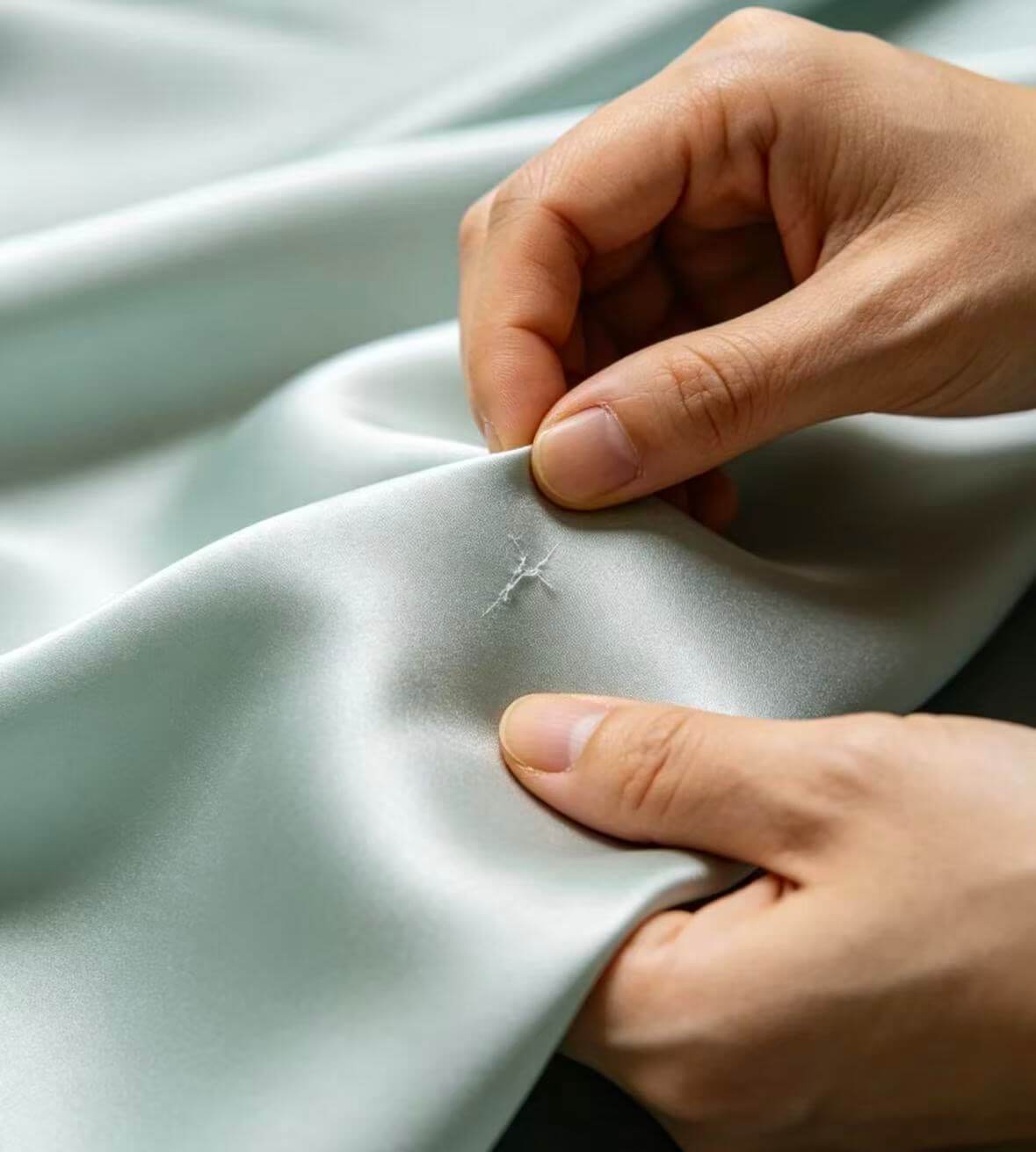
These flaws are not rare — they happen even in 6A grade silk. The difference between a professional buyer and a frustrated designer is knowing what to look for, how to spot it, and what to accept or reject. I'm Liu from Silk.Sale. I inspect silk rolls in Nanchong's mills every week. Here are the three most common defects I see — and how to catch them before cutting.
Flaw #1: Warp Streaks
Yarn Tension Variation / Color Bars
What it looks like: Thin, shiny or dull lines running lengthwise along the fabric. They often appear as subtle color changes — lighter or darker bands — most visible when held at an angle under natural light. In solid colors, they look like "stripes" that shouldn't be there.
What causes it: Uneven tension during warping or weaving. When some warp yarns are stretched more than others, they take dye differently. More common in lower-grade silk (3A–4A) but can happen in 6A if the mill rushes production. Especially visible on satin and charmeuse because the smooth surface reflects light unevenly.
How to inspect: Hold the fabric against a window or under a daylight lamp. Stretch it gently on a diagonal. Warp streaks will appear as subtle "bars" of light and shadow. Run your hand across — if you feel uneven thickness, that's another clue.
Acceptance standard: For luxury garments, warp streaks should be nearly invisible at 1 meter distance. More than 2 noticeable streaks per roll is a reject. For lining or hidden areas, minor streaks may be acceptable.
Flaw #2: Weaving Defects
Broken Ends, Holes & Slubs
What it looks like: Small holes, missing threads, thick knots, or uneven bumps on the surface. Broken ends appear as a thin gap where a warp yarn is missing. Slubs are thick, uneven sections of yarn that look like tiny pills or lumps.
What causes it: Broken ends happen when a warp thread snaps during weaving and the loom doesn't stop immediately. Slubs come from irregular raw silk thickness — lower-grade silk has more. In 6A silk, slubs should be rare, but they still occur.
How to inspect: Use a light table or hold the fabric against a bright window — defects become obvious when backlit. For slubs, run your fingers slowly over the fabric; you'll feel the bump before you see it.
Pro tip: Always check the first and last 5 meters of a roll. Most weaving defects cluster at the beginning or end of a production batch.
| Defect Type | Description | Acceptance (per 10m roll) |
|---|---|---|
| Broken end (>2 cm) | Missing warp thread with visible gap | Zero tolerance |
| Small hole (<2 mm) | Pin-sized opening from broken pick | Max 2, not clustered |
| Slub (visible bump) | Thick, uneven yarn section | Max 3, length under 3 mm |
| Reed mark | Vertical line from bent reed wire | Reject if visible on face side |
Flaw #3: Stains, Oil Spots & Rust Marks
Surface Contamination
What it looks like: Dark spots, yellowish stains, or small brown/orange marks. Oil spots appear translucent or slightly darker than the fabric. Rust marks are tiny orange-brown dots, often near the edges where metal clips or rollers touched the fabric.
What causes it: Machine lubricants dripping onto the fabric during weaving or finishing. Rust comes from old metal rollers or clips. Water stains happen if the fabric gets wet during storage and dries unevenly.
How to inspect: Unroll 3–5 meters and scan both sides. Stains are easier to see on light-colored silk. For dark silk, use a bright flashlight at a low angle — the shadow will reveal surface contamination. Check the selvage edges carefully; stains often start there.
Acceptance standard: Any stain larger than 1 cm² is a reject. Small faint spots (under 0.5 cm) may be acceptable if they can be cut around, but ask for a discount. Oil spots are especially problematic because they often don't wash out completely.
Bonus: Hidden Flaw — Shading (Lot-to-Lot Color Variation)
This isn't a single roll flaw, but a batch issue. If you order 500 meters in five rolls, all rolls should be the same color. But dye lots vary — sometimes significantly.
How to check: Lay pieces from different rolls side by side under consistent daylight. The human eye is excellent at detecting even small variations. For precision, a ΔE (color difference) of less than 1.5 is excellent; ΔE 1.5–3.0 may be acceptable for separate pieces but not the same garment; ΔE > 3.0 is a reject.
Why Inspect Before Cutting — Not After
Once you cut into a roll, you've accepted it. Most suppliers will not accept returns on cut fabric. That's why pre-cutting inspection is critical. You have three options:
- Do it yourself — Unroll and check every meter. Takes time and a good light source, but it's free.
- Hire a third-party company — SGS or Bureau Veritas will inspect for you, but expect $300–600 per day plus travel.
- Work with a sourcing partner who inspects for you — At Silk.Sale, we inspect every roll before it leaves the mill, send you a video report, and reject anything that doesn't meet standards. You only pay a 3–9% commission when you buy.
Quick Reference Checklist
| Flaw | Inspection Method | Accept | Reject |
|---|---|---|---|
| Warp streaks | Diagonal stretch, daylight | Invisible at 1 m | Visible stripes |
| Broken ends / holes | Light table or window | 0–2 tiny holes per 10 m | Any hole >2 mm or open gap |
| Slubs | Touch + visual | Few small slubs (under 3 mm) | Large or frequent slubs |
| Stains / oil spots | Scan both sides | Only tiny, faint spots | Any stain >1 cm² |
| Color shading (between rolls) | Side-by-side comparison | ΔE < 2.0 | Obvious visible difference |
"The first time I inspected a roll myself, I found a 15 cm oil stain hidden in the middle. My supplier refused to replace it because I had already started cutting. Now I let Silk.Sale do the inspection before shipment — no surprises." — A Vietnamese fashion brand owner
Final Thought: Trust But Verify
Even the best mills produce flawed fabric occasionally. The difference between a good sourcing experience and a bad one is catching those flaws before they become your problem. Whether you inspect yourself or partner with someone who does, never skip this step.
I find. I check. You relax.