You touch a piece of good silk, and one word comes to mind: refined.
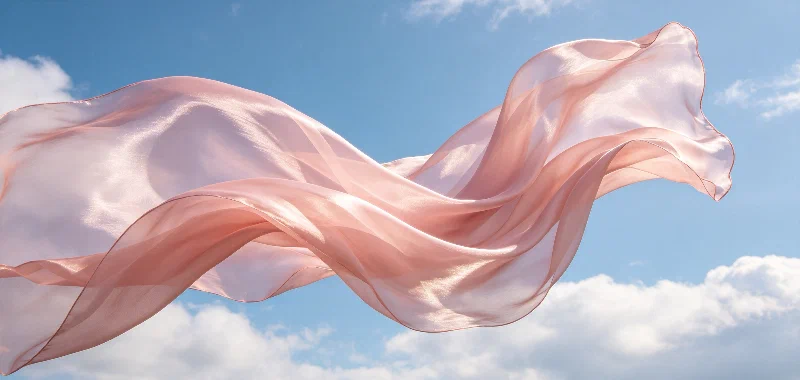
Its luster is not a harsh, glaring shine – it is a soft, deep glow, like moonlight on water, not a fluorescent lamp on plastic. Where does this luster come from? Why do some silks look "brilliant" in just the right way, while others look simply "bright" and vulgar?
The answer lies under the microscope.
The Triangular Cross-Section of Silk Fibre
Most natural fibres have round or oval cross-sections. Cotton is kidney-shaped; wool is a cylindrical shape covered with scales. But silk is different – its cross-section is approximately triangular.
This triangular shape determines how light travels inside the fibre.
When light hits the silk surface, part of it is reflected, and part enters the fibre. In a round fibre, light reflects directly back, creating a harsh "highlight". But in a triangular silk fibre, light undergoes multiple refractions and reflections inside – entering from one side and exiting from another, with a longer, more complex path.
The result: the reflected light is dispersed, soft, and layered. This is the physical basis of silk's "refined" luster.
How Is the Triangular Cross-Section Formed?
The shape of the silk fibre is "extruded" by the silkworm as it spins.
Silk protein is liquid in the silkworm's gland. When the silkworm spins, the liquid is squeezed through a tiny duct and solidifies in the air. The cross-section of this duct (the spinneret) is itself triangular, so the extruded liquid retains that triangular shape after solidification.
Think of it like extruding pasta through a triangular die – the shape is determined by the "mould".
Once formed, this triangular cross-section is fixed. Unlike wool or cotton, whose shape can be altered by finishing, silk's cross-section is determined at the moment it is spun and remains unchanged for its entire life.
Silk's triangular cross-section is unique among natural fibres. It is the primary reason why genuine silk has a depth and subtlety of luster that synthetic imitations cannot replicate.
How the Triangular Cross-Section Affects Fabric Aesthetics
First, luster has depth. Because light refracts multiple times inside the fibre, silk's luster is not superficial – it emanates from within. This "internal glow" gives the fabric a sense of depth, rather than looking like a coat of reflective paint.
Second, luster changes with angle. When you rotate a piece of silk, the luster shifts – some areas brighten, others darken, creating subtle gradations. This is because light paths in a triangular cross-section vary with angle. This dynamic quality makes silk feel "alive".
Third, luster is not uniformly "bright". The sheen of good silk is the sum of reflections from countless triangular cross-sections. Microscopically, each fibre's reflection is slightly different; macroscopically, the overall luster is soft and layered.
How Different Weaves Affect Luster
The same silk yarn, woven differently, will have completely different luster.
- Satin weave (like charmeuse): Long floats on the surface create large, flat reflective areas – luster is strongest and most pronounced. This is why satin silk looks the "brightest".
- Twill weave (like silk twill): Shorter floats with a diagonal texture – light paths are more dispersed, producing a softer luster with more texture.
- Plain weave (like habotai): The tightest interlacing, no long floats – light reflection is most scattered, giving the softest, most matte finish.
The same silk can range from "mirror-like" to "jade-like" brilliance simply by choosing a different weave.
Why Can't Synthetics Imitate Silk's Luster?
Many synthetic fabrics claim to have "silk-like luster". But if you look closely, the difference is obvious.
Synthetics (like polyester, nylon) have round cross-sections. Light reflects mainly by specular reflection – the reflection angle is narrow, the luster is "dead white", and it does not change richly with angle.
More importantly, synthetic luster is "floating" on the surface – you don't sense light emerging from within. This is why imitation silk often looks "harshly shiny".
What This Means for Sourcing and Design
If you are a buyer or designer, luster is an important indicator of silk quality.
- Good silk luster is alive – it changes naturally as you rotate the fabric. If a fabric labelled "silk" has a static luster no matter how you turn it, it is likely not genuine mulberry silk.
- Different luster suits different uses – high-luster charmeuse for eveningwear and sleepwear, medium-luster twill for shirts and jackets, low-luster habotai for linings and summer tops.
- Luster can indicate finishing quality – heavy softening or sand-washing can dull the natural luster. If you want the "pure" silk sheen, you need to confirm the mill has not over-processed the fabric.
Silk's luster is determined from the moment the silkworm spins its filament. The triangular cross-section, light refraction, and fabric weave – each step shapes that unique "refined" quality.
Good silk luster is a delicate dialogue between light and material – a dialogue that has been going on for over four thousand years.
Frequently Asked Questions
I find. I check. I seal. You relax.