Still patting yourself on the back for saving a few dollars per metre? In 2026, that might be your brand's most expensive "saving".
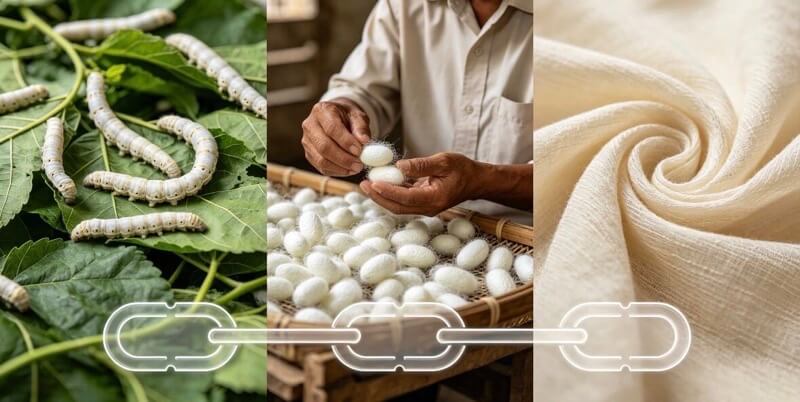
Over the past few years, through the Silk.Sale blog, I've connected with hundreds of independent designers and small brand founders. Almost every conversation starts with the same question: "Can you give me the lowest price?"
But in 2026, a meaningful shift is happening. The sharpest, most forward-looking brands are asking a completely different question: "Can I trace this silk back to the village and the mill where it was made?"
This isn't just a trendy "ethical" concern. It's about real risks and long-term interests for your brand in 2026 and beyond. Today, I want to talk about why "traceability" has quietly overtaken "low price" as the most important decision factor in silk sourcing.
1. The Hidden Cost Sheet Behind "Low Price"
Let's face it: chasing the lowest price is business instinct. But as someone who has worked deeply in the Nanchong silk belt, I know that a suspiciously cheap roll of good silk often means some cost has been shifted elsewhere. In 2026, those costs are more likely to bounce back and hit your brand directly.
| What you "save" | The real cost in 2026 |
|---|---|
| Uncertain raw silk | Mixed with lower-grade cocoons → poor strength, colour fastness, high return rates. |
| Vague production origin | Informal mills with weak environmental/labour standards → reputation risk if exposed. |
| Skipped quality control | Missing pre‑shrinking or inspection → skewing, colour variation, excessive shrinkage → production delays + financial loss. |
When you pay only for the fabric, you may not be paying for certainty and peace of mind. And in 2026, that peace of mind is more expensive than ever.
2. What Does "True Traceability" Mean in Silk Sourcing?
Traceability isn't a vague statement like "made in China". In a long-chain industry like silk, real traceability means transparency and a chain of accountability.
For you — a brand builder who wants lasting value — a traceable supply chain should answer three core questions:
- Is the origin trustworthy? Does your silk come from a large‑scale, modern mulberry base like Nanchong? Can you pinpoint the specific district?
- Is the process transparent? Are the key steps — cocoon drying, reeling, weaving, dyeing — done in certified, well‑managed facilities with proper environmental controls?
- Is the quality guaranteed? When a problem occurs, can you quickly identify which link in the chain failed and work with the responsible party to fix it — instead of getting lost in a maze of traders?
3. How to Verify Your Supplier's Traceability
The good news: in 2026, verifying traceability isn't hard — you just need to ask the right questions. Here's a practical checklist you can use right away:
- Ask for a specific "origin certificate" — not just "China", but e.g. "Nanchong, Sichuan" or "Huzhou, Zhejiang".
- Map the supply chain layers — is your supplier working directly with the mill, or through multiple intermediaries? Fewer layers mean more transparency and better value.
- Request live video or a virtual tour — any responsible source supplier should be open to a genuine video walk‑through of their facilities.
- Look beyond basic certifications — OEKO‑TEX and GOTS are good starting points. Go further by asking for ISO 9001 (quality) or ISO 14001 (environmental) management system certifications.
A supplier who hesitates or gives vague answers to these questions is likely hiding something. Transparency is non‑negotiable in 2026.
4. The Long View: How Traceability Builds Brand Value
Choosing traceability is essentially choosing a long‑term partnership with your supply chain. In 2026, this choice delivers clear commercial advantages:
- Reduces long‑term risk — a traceable chain helps you avoid legal and PR crises related to environmental or labour issues, which are increasingly scrutinised.
- Enables authentic storytelling — "Our 6A mulberry silk comes from a modern silk town in Nanchong, China, with decades of heritage" is a far more powerful story than vague "luxury" labels.
- Builds stable partnerships — when you stop haggling over a few cents per metre and instead grow together with a trusted mill, you get consistent quality, flexible lead times, and priority production support.
At Silk.Sale, we've always believed that good silk should carry value — not just a price tag.
That's why we combine Nanchong's origin advantage with a full‑chain quality and traceability system. When you work with us, you get more than a roll of certified 6A silk — you get a clear, verifiable origin story and the confidence of a reliable partnership.
Frequently Asked Questions
I find. I check. I seal. You relax.