Today, you can order silk online with a single click. But two thousand years ago, it was worth more than gold.
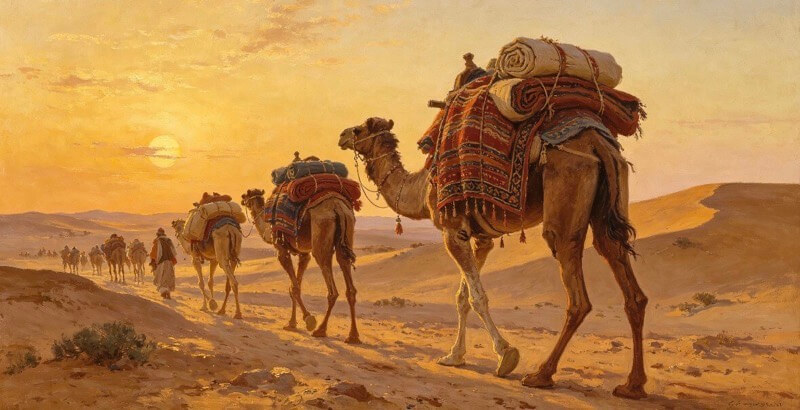
The Romans nearly emptied their treasury for it. The Persians grew rich by monopolising the trade for centuries. And the Chinese exchanged this lightweight fabric for warhorses, gems, and unimaginable wealth.
This is not fiction. This is real history — a trade network that spanned millennia.
How Did Silk First Reach the West?
China was the first country to domesticate silkworms and produce silk. Archaeological evidence shows sericulture began in the Yellow River basin around 6,000 years ago. By the Shang and Zhou dynasties, silk had become a significant ceremonial and trade item.
But silk's global journey truly began in the Han Dynasty.
In 138 BCE, the diplomat Zhang Qian was sent to the Western Regions. His political mission ultimately failed, but he accidentally opened a corridor from China to Central Asia – later named the "Silk Road" by the German geographer Ferdinand von Richthofen.
This road stretched from Chang'an (today's Xi'an), through the Hexi Corridor, Xinjiang, over the Pamir Mountains, into Central Asia, Persia, and finally to the Mediterranean coast. It covered roughly 7,000 kilometres.
Along this route, silk was passed from hand to hand, each time marked up. A bolt of silk that cost a few hundred Chinese coins could sell in Rome for its weight in gold.
Silk's "Currency" Status in the Ancient World
For a long time, silk was not just a commodity – it was currency.
During the Han Dynasty, the imperial court used silk to pay frontier nomads in exchange for horses, cattle, and sheep. At archaeological sites in Xinjiang and the Hexi Corridor, researchers have found scraps of silk cut into fixed sizes and used as money.
In Central Asia, silk was hard currency. Caravans could carry silk across multiple countries without needing to exchange money. In Rome, silk became a status symbol for the elite. Emperor Tiberius once banned men from wearing silk because he deemed it too extravagant – but the ban only made it more desirable.
Historians estimate that Rome's annual spending on silk consumed 5–10% of the empire's total revenue.
The "Silk Wars" Between the Persians and the Byzantines
The enormous profits from the silk trade attracted the attention of the Persians. They controlled the middle section of the route – from Central Asia to the Mediterranean. Chinese merchants sold silk to Central Asian middlemen, who then resold it to the Romans at a massive markup.
In the 6th century CE, Byzantine Emperor Justinian I had had enough. He sent agents to infiltrate the Persian empire and steal the secret of sericulture. According to legend, two Nestorian monks smuggled silkworm eggs out of China – hidden inside hollow walking sticks.
This is the most famous "commercial espionage" case in silk history.
Those eggs were brought to Byzantium, and sericulture began to develop in the Mediterranean. For the first time, Europeans had their own silk industry – and were no longer entirely dependent on eastern imports.
How Silk Transformed Europe's Industrial Landscape
From Byzantium, silk-weaving technology gradually spread westwards. By the Middle Ages, Italian cities like Lucca, Venice, and Florence became the heart of European silk production. In the 16th century, Lyon, France, rose to become the largest silk-producing centre in Europe.
European silk was already of high quality – but the finest raw silk still came from China.
This pattern continued until the late 18th century. As international trade expanded, Chinese raw silk continued to flow to Europe through Canton (Guangzhou), but by then Europe had developed its own strong silk industry that could compete with Eastern products.
Decline and Revival of the Silk Trade
In the mid-19th century, the European silk textile industry reached its peak. But two major events disrupted it: firstly, a silkworm disease (pébrine) devastated sericulture in France and Italy; and secondly, the invention of rayon – cheap, mass-producible – quickly captured the lower and mid-range markets.
The market share of natural silk shrank dramatically.
But real silk never disappeared. Its unique properties – breathability, moisture absorption, gentle luster, and skin-friendliness – remain impossible for synthetics to fully replicate. Today, annual global silk production stands at around 70,000 tonnes, with China still accounting for over 70% of that.
Why This History Matters
Silk is not just a fabric. It was a driver of global trade, a currency, a symbol of power, and a vehicle for the spread of technology. Understanding this history helps you appreciate why silk has occupied such an extraordinary place in human civilisation.
The silk we source today is the same material that Roman aristocrats wore two thousand years ago. The same fibre. The same substance. The only difference is that it is no longer "soft gold" – but it is still a material that deserves to be treated with respect.
Because in three thousand years, very few things have been so consistently valued by humanity.
Frequently Asked Questions
I find. I check. I seal. You relax.