The silk you wear every day – your shirt, your duvet, your scarf – holds secrets you'd never guess.
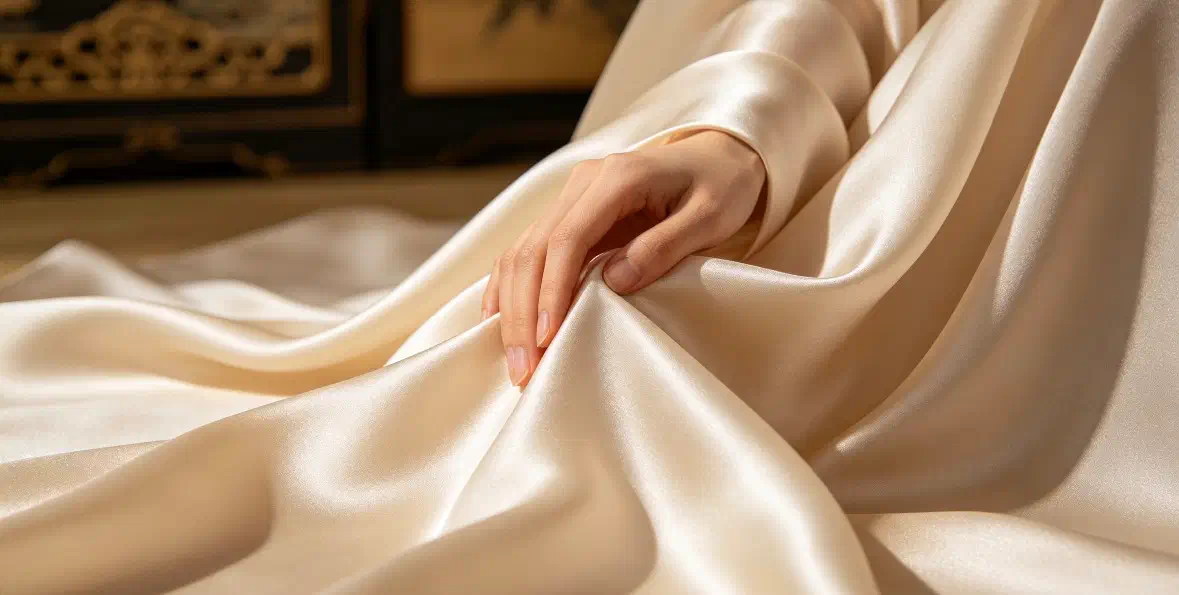
Here are ten cool facts about silk that might just change how you see it.
1. One cocoon can spin 1,500 metres of silk
A single cocoon yields a continuous filament of 700 to 1,500 metres. Spring cocoons can reach 900–1,200 metres, and premium breeds can exceed 1,200 metres – enough to circle a running track three times.
2. Silk is ten times finer than a human hair
A silk fibre is about one-tenth the diameter of a hair. Its cross-section is a blunt triangle, 70–80 microns long and 9–12 microns short. This ultra-fine fibre carries the entire weight of the silkworm.
3. 25 grams of mulberry leaves yield just 0.5 grams of silk
A silkworm lives about 28 days, eats roughly 25 grams of mulberry leaves, and produces only 0.5–1 gram of silk. That's a conversion rate of about 4%. No wonder silk is expensive – it's a slow, inefficient miracle.
4. A silk dress needs thousands of silkworms
A 1‑kilogram silk garment takes about 3,000 cocoons. A 1‑kg silk duvet needs about 5,000 cocoons. A silk robe? Over 2,000. Your silk shirt is the work of more than a thousand silkworms.
5. A silkworm is a moth larva, not a worm
The silkworm is the caterpillar of the domesticated silk moth (Bombyx mori). It moults five times, and by its fifth instar, its silk glands make up 25% of its body weight. After spinning its cocoon, it pupates and emerges as a moth – but in commercial production, it's killed before that to preserve the filament.
6. Silk sparked a 20‑year war
In the 6th century, the Persians controlled the middle of the Silk Road, cutting off direct trade between China and Rome. The two empires fought for 20 years over silk access. Eventually, two monks smuggled silkworm eggs out of China in hollow walking sticks, breaking the Chinese monopoly and establishing sericulture in Byzantium.
7. Silk was once worth its weight in gold
In ancient Rome, silk traded at par with gold. The empire spent 5–10% of its annual budget on silk. Roman senators repeatedly tried to ban men from wearing it – but the bans only made it more desirable.
8. Silk is stronger than steel – weight for weight
On a weight‑for‑weight basis, silk's tensile strength reaches about 790 MPa – higher than steel. Spider silk is even stronger (about five times steel), but spiders can't be farmed because they're carnivorous and territorial.
9. Silk goes to space and into your body
Silk is used in surgical sutures – over 300 million procedures annually. It's also made into artificial skin, biodegradable bone screws, and nerve repair tubes. Silk even went to space – the Shenzhou‑11 spacecraft carried six silkworms to study spinning in microgravity.
10. Europeans thought silk grew on trees
Before silkworm eggs reached the West, Europeans had no idea how silk was made. Some imagined it grew on trees like cotton, or hung from branches like hair. It wasn't until the eggs were smuggled out that they finally discovered the truth – it comes from a worm.
15 kilograms of silk filament, laid end to end, could circle the entire Earth.
Frequently Asked Questions
I find. I check. I seal. You relax.