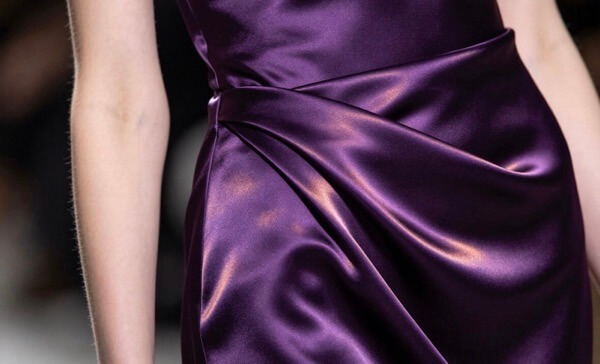
A designer friend who specialises in haute couture asked me recently: "Why does this piece of silk look expensive while another one — also labelled silk — looks cheap?" I held both fabrics up to the light. The answer was immediate. The difference between these two fabrics isn't about price. It's about soul. And silk's soul is in its luster.
How Does Silk Luster Come About?
In simple terms, the cross-section of a silk fibre is triangular. This triangular structure allows light to refract and reflect multiple times within the fibre, resulting in a soft, shifting, and deep luster. It's not a harsh, flat shine — it's alive.
Synthetic fibres, on the other hand, mostly have round cross-sections. Light reflects directly off the surface, producing a rigid, glaring brightness. When it feels harsh on your eyes, that's plastic reflection — not silk.
Think about it: why is diamond more valuable than glass? Because diamond's sparkle is alive, while glass's shine is dead. Silk and synthetics are essentially the same relationship.
What Determines Luster Quality?
1. Raw Material Grade
6A grade raw silk has long, uniform fibres with minimal impurities. When woven, the fabric reflects light evenly from every angle. Lower-grade silk has inconsistent fibre thickness, creating uneven reflection — you'll see splotchy, irregular sheen that never looks quite right.
2. Weaving Process
Satin weaves show more luster than plain weaves because the long floats provide more reflective surfaces. High-quality charmeuse weaves look like a still water surface. But some factories rush production — increasing loom speed and destabilising yarn tension — resulting in hidden streaks that kill the luster from the inside.
3. Finishing
Raw silk straight out of the cocoon is covered with sericin — it feels stiff and lacks shine. Only through degumming, softening, sand-washing, and setting does the luster truly "wake up". The quality of finishing depends entirely on the mill's process control and cost investment. I've seen factories cut finishing steps to save money. The fabric looks acceptable at first, but the difference is obvious the moment you compare it side by side with a properly finished piece.
When evaluating a silk sample, check luster along three axes: warp direction (lengthwise), weft direction (widthwise), and diagonal. Premium 6A silk should show consistent, shifting luster in all three directions. Inconsistency in any axis points to uneven yarn tension or a lower fibre grade.
How to Judge Fabric Quality by Luster
First, rotate the fabric under light. If the luster shifts naturally as you turn it, the fibres are neatly aligned and the weave is tight. If the sheen stays flat no matter how you turn it, the fibre grade is low or the weaving is poor.
Second, look for depth. Premium silk luster resembles jade — light enters the surface and diffuses internally, giving a "moist" richness. Poor-quality silk or fakes have luster that sits only on the surface and looks flat. There's no depth, no interior glow.
Third, slide the back of your hand gently across the fabric. Good silk feels smooth but not slippery, with a subtle resistance — like touching a thin film of fine oil. After a few times, your hand will remember the feel. This combination of luster and hand feel together is the most reliable field test there is.
Different Weaves, Different Luster
- Charmeuse — the brightest luster, best for evening gowns, sleepwear, and luxury lingerie.
- Crepe de Chine — soft, subtle luster with a slightly matte surface, ideal for blouses and dresses.
- Habotai — medium luster, often used for linings or lightweight summer tops.
Different fabrics, different luster — each has its purpose. Choosing the right one isn't just about aesthetics; it's about understanding what the garment needs to do.
Good silk luster is alive. Poor quality or fake silk luster is dead. Once you've held the real thing, you can never be fooled again.
What This Means When You're Sourcing
When you're sourcing, don't just take a supplier's word for "6A grade". Look at the luster. Rotate it under natural light. Feel the depth. Ask for a video inspection report — because luster is something that needs to be seen, not just described.
At Silk.Sale, I inspect every roll personally in Nanchong under both natural and controlled lighting. If the luster doesn't meet the standard, the roll doesn't ship — it's that simple.
Frequently Asked Questions
I find. I check. I seal. You relax.