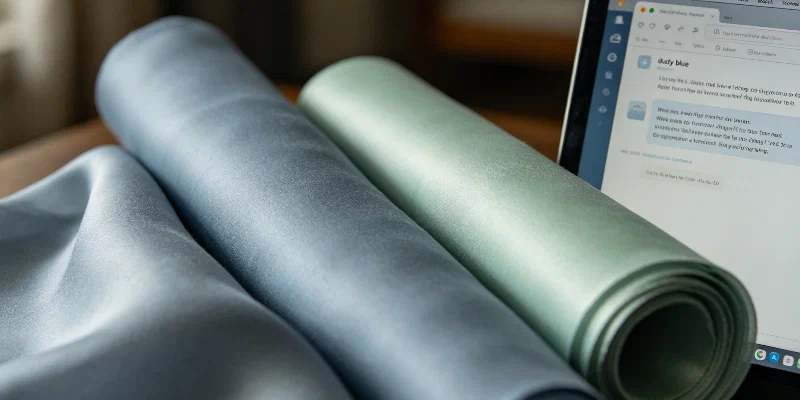
The email usually arrives with a photo attached. Two rolls of silk, side by side, labelled with the same colour name: "dusty blue". One is soft and grey-toned. The other leans faintly green. The buyer's message is short: "This isn't the same colour. What do I do?"
This is one of the most common — and most expensive — problems in silk sourcing. It's not a defect in the traditional sense. There's nothing broken, nothing torn, nothing stained. But if the two rolls are meant to become one garment, the whole order is unusable. And often, by the time the buyer discovers it, the fabric has already left China.
The good news: shade variation is predictable, and it can be controlled. The bad news: it can't be eliminated entirely. Understanding the difference between those two facts is what separates buyers who get consistent colour from buyers who keep sending complaint emails.
First, a distinction that matters: shade variation vs colour fastness
Buyers often use these terms interchangeably. They're completely different problems, and they happen at different stages.
| Issue | What it means | When it shows up |
|---|---|---|
| Shade variation | Different rolls or batches of the same colour don't match each other | Before shipment — at the mill or during QC |
| Colour fastness | The colour fades, bleeds, or transfers during washing, sunlight, or rubbing | After the customer wears or washes it |
This article is about the first problem. If you're concerned about how silk holds up in use, see our separate guide to silk colour fastness.
Why silk shade variation is normal — not a supplier failure
When buyers see two different shades, the instinct is to assume the supplier cut corners. Sometimes that's true. But more often, the cause is inherent to how silk is dyed.
1. Silk is a natural protein fibre
Unlike polyester or nylon, silk is produced by silkworms. Every batch of raw silk has slightly different fibre properties — the thickness of the silk gum, the degree of degumming, the surface texture. Reactive dyes bind to protein fibres differently depending on those conditions.
Two batches of "the same" raw silk, dyed in "the same" bath, can absorb dye at slightly different rates.
2. Dye bath conditions shift
Even in a well-run dye house, small variations matter. Water temperature, pH, dye concentration, and the timing of chemical additions all influence the final shade. A one-degree temperature difference between two dye runs can produce a visible shade shift.
3. Bath size and dye exhaustion
Large dye baths and small dye baths don't behave identically. In a large bath, dye distribution is less uniform, and the exhaustion rate at the edges may differ from the centre. This is why a single order split across two dye runs — or two machines — often comes back slightly mismatched.
Zero variation is not achievable in silk. What is achievable is controlled variation — where every roll falls within an agreed tolerance. The buyer's job is to define the tolerance; the supplier's job is to meet it.
The three types of shade variation
Not all shade problems are the same. Each has a different cause and a different fix.
1. Batch-to-batch variation
Two orders of the same colour, produced weeks apart, come back slightly different. This is the most common — and the most expected — form of variation.
Cause: Different raw silk batch, different dye run, seasonal temperature differences.
Fix: When possible, order all needed quantity in a single production run. If you must split, ask the mill to dye all batches back-to-back using the same raw silk lot.
2. Dye lot variation (within one order)
One order, one colour, but the rolls inside don't match each other. This is more serious — because it means the fabric can't be used together.
Cause: Order exceeded a single dye bath capacity, so it was split across two or more runs. Or the mill used two different machines.
Fix: This should be caught at inspection. Always ask the mill how many dye lots your order was split across — and insist on shade-matching within the order.
3. Metamerism (light-source shade shift)
The rolls match under the mill's lighting, but look different in your studio. Or they match in daylight, but diverge under shop lights.
Cause: Two fabrics with different dye chemistry can appear identical under one light source and different under another. This is called metamerism.
Fix: Always agree on the lighting conditions for approval. The industry standard is D65 — a daylight simulation. If you approve under D65 and inspect under D65, you eliminate most metamerism surprises.
The 5 checks that prevent shade problems before you order
Most shade problems are preventable — not at inspection, but at the ordering stage. Here's what to lock down before production begins.
- Approve a physical colour standard, not just a Pantone number. Pantone is a starting point, but silk doesn't match paper. Ask for a dyed silk swatch and approve that. Note the lighting condition under which you approved it.
- Confirm a single dye lot — or plan for multiple. Ask the mill directly: "Will this order be one dye lot or several?" If it's several, ask whether they can shade-match all lots to each other before shipment.
- Set a ΔE tolerance in writing. ΔE is the standard numerical measure of colour difference. For silk garment fabric, a common tolerance is ΔE ≤ 1.5 between rolls, and ΔE ≤ 2.0 for the overall batch. For lining or non-visible parts, ΔE ≤ 3.0 is often acceptable.
- Keep a sealed reference sample. Both you and the mill should keep a sealed, signed reference swatch from the approved dye run. This is your evidence if a dispute arises.
- Specify the inspection lighting. State D65 in your contract. It removes ambiguity and protects both sides.
How to inspect shade consistency before shipment
Even with the best preventive work, inspection is where shade problems get caught. Here's what a proper shade check looks like.
Roll-to-roll comparison
Lay rolls side by side, edge to edge, under D65 lighting. Look along the full length, not just at the fold. Rotate the rolls so you're comparing the same face of the fabric.
Head-to-tail check on a single roll
Cut a small swatch from the beginning of the roll and another from the end. Place them side by side. If they don't match, the roll itself is inconsistent — this happens when a mill dyes fabric in a continuous machine where the start and end pass through the bath at different times.
Folded vs open
Silk looks different when folded than when laid flat. Check the fabric both ways — customers will see it in both states.
Photograph under standard light
Any dispute should be documented with photos taken under consistent lighting. Phone photos taken under mixed indoor light are unreliable evidence — they can make a small variation look large, or the reverse.
By the time your goods arrive and you notice a shade problem, it's too late — the fabric is in your warehouse and the mill has moved on. This is the single strongest argument for pre-shipment inspection. Every shade issue I've caught at the mill saved a buyer a rejected order.
What to do if you find a shade problem
There are only three options, and the right one depends on severity and where the fabric will be used.
| Option | When it makes sense | Risk |
|---|---|---|
| Re-dye | Small variation, fabric not yet cut, mill still has the batch | Silk degrades slightly with each dye cycle — second dyeing is risky |
| Accept at a discount | Variation is minor, or fabric will be used for lining, interior panels, or samples | Must be agreed in writing before cutting |
| Reject | Variation exceeds agreed tolerance, or fabric is for main visible panels | Relationship cost, delay, and possible loss of deposit |
The key is to make this decision before the fabric leaves the mill. Once it ships, you lose leverage. Re-dyeing after arrival is impractical, and rejection becomes a legal dispute rather than a quality fix.
The bottom line
Silk shade variation is not a sign of a bad supplier. It's a natural consequence of dyeing a natural fibre. What matters is whether the variation is controlled — whether every roll falls within an agreed tolerance, and whether the buyer knows what that tolerance is.
Three things make the difference:
- Define the standard before ordering — physical swatch, ΔE tolerance, and lighting condition
- Inspect before shipment — roll-to-roll, head-to-tail, under D65
- Decide fast if there's a problem — while the fabric is still at the mill
If you're sourcing silk and colour consistency keeps biting you, that's what a pre-shipment QC partner is for. I catch shade problems before they ship — not after they arrive.
I find. I check. You relax.